Employee
Center
The organization ran two separate service portals: one for IT and one for HR, each with its own navigation, visual language, and support model. The mandate was to consolidate them into a single Employee Center Pro experience: one front door for the whole enterprise.
The work did not start clean. An initial vendor proposal had already been rejected by stakeholders as too unrefined to build on, and the effort was stalling. My team was brought in after that rejection, stepping into a project already behind, already contested, and missing a clear owner for design quality. From the outset the role was two things at once: design authority for the experience, and quality gatekeeper for everything the vendor produced.
No one was holding a standard. I built a working prototype that served a dual purpose: a technical specification the vendor could build against, and a quality benchmark the work could be measured against. Its credibility as a reference depended on the craft holding up through every technical adjustment, so design integrity was treated as a build requirement, not a finishing pass.
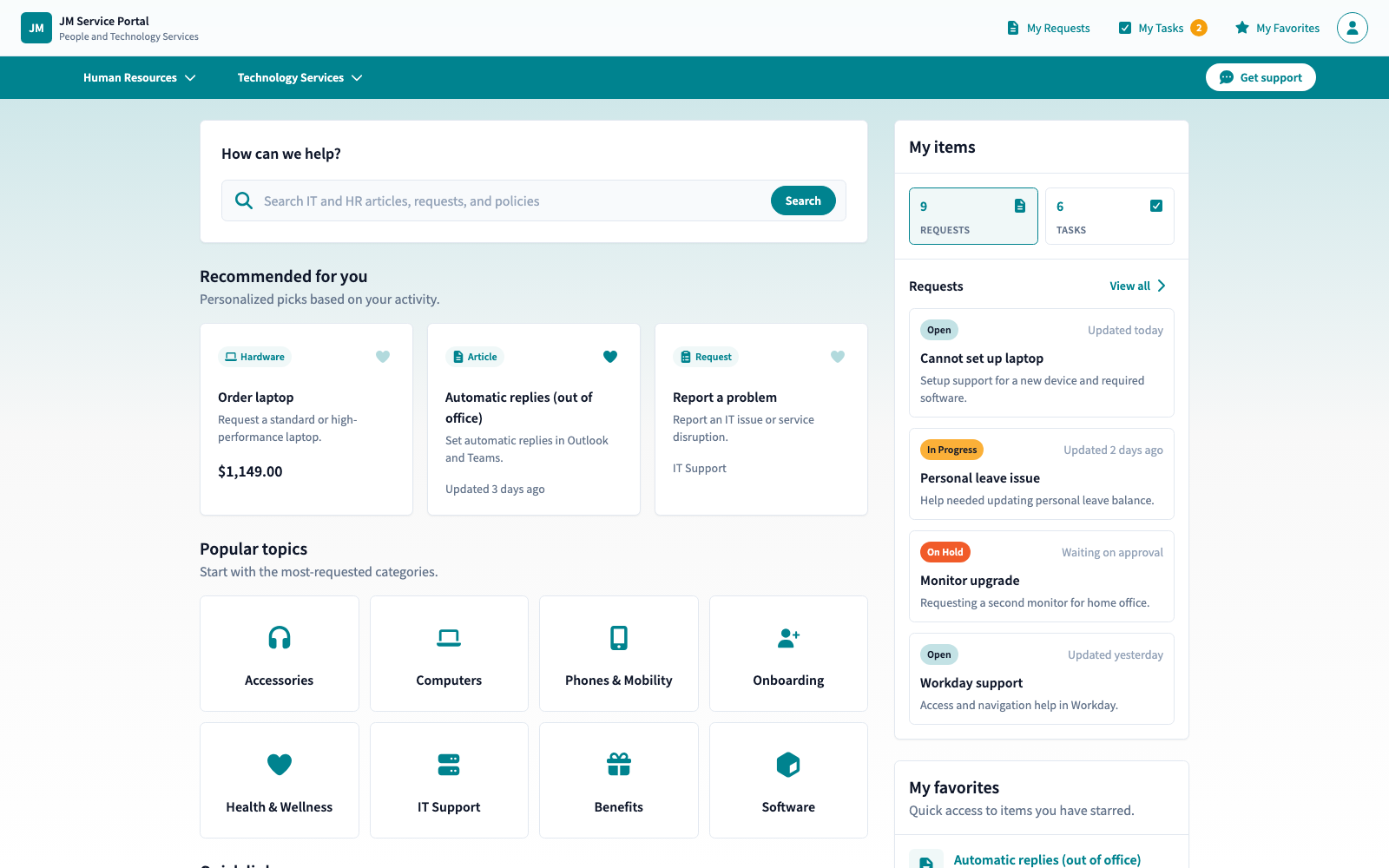
I established and defended a three-tier navigation model matched to user intent rather than internal org structure: a homepage hero search for discovery and self-service, a persistent Get Support path for users who arrive already knowing they need help, and a mega menu for navigation and exploration. The principle underneath it was simple: users with uncertain intent need search-first flows, while users with resolved intent need direct escalation. That became the spine of the information architecture.
Accessibility was non-negotiable and built in throughout, not bolted on at the end. When the vendor pushed back on design decisions about iconography, navigation hierarchy, and tab structure, I separated genuine constraints from scope avoidance dressed up as design rationale: conceding where it was reasonable, holding firm where the experience depended on it. The most effective lever was referencing the vendor's own prior documentation back to them.
Tier one: a homepage hero search for discovery and self-service, with recommended items and popular topics surfacing the most-requested paths.
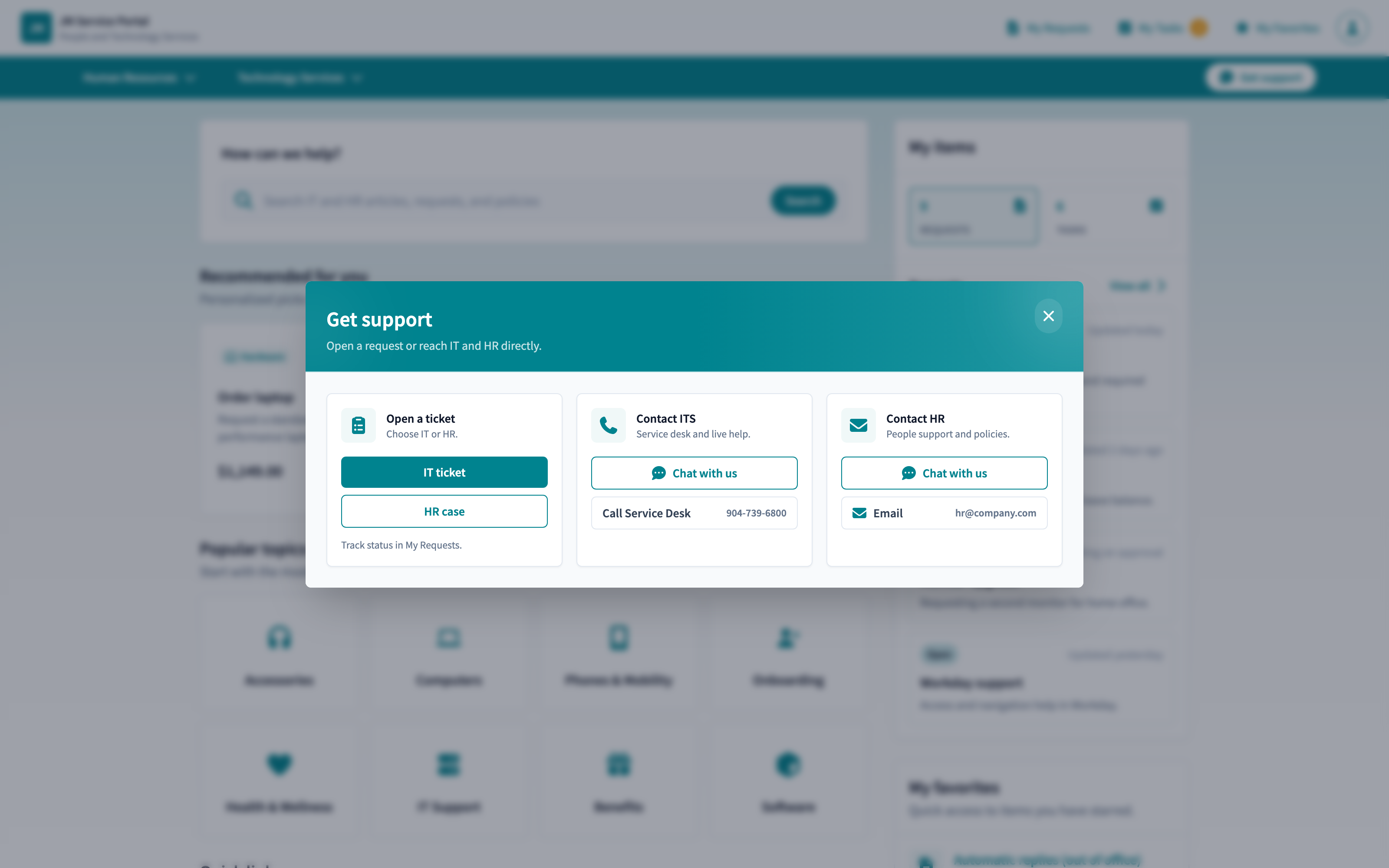
Tier two: a persistent Get Support path for users who arrive already knowing they need help: open a ticket, or reach IT and HR directly.
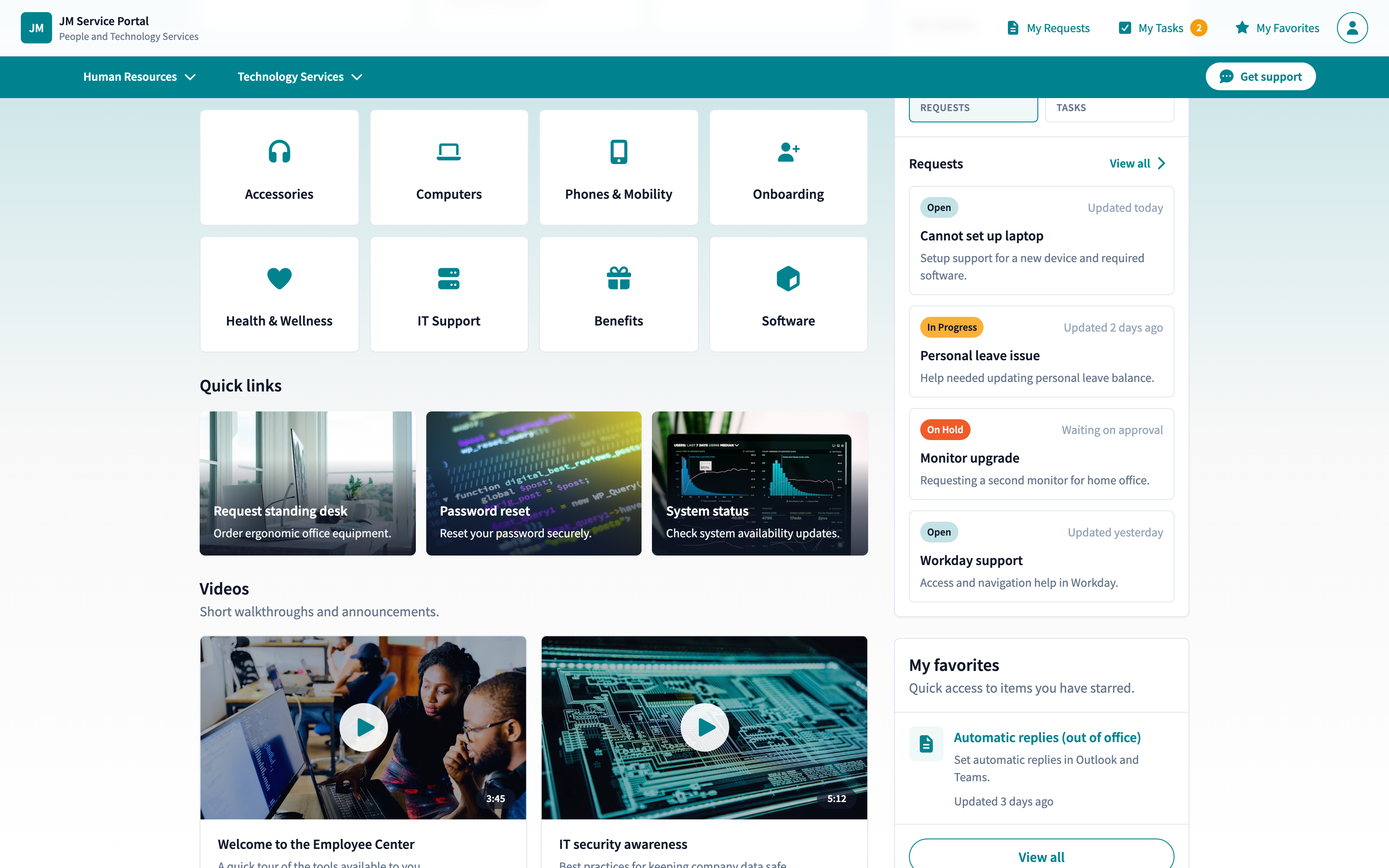
One front door: popular topics, quick links, and walkthroughs unify the IT and HR self-service that used to live in two separate portals.
The portal touched four functions that were not used to building together: IT, HR, Corporate Communications, and Organizational Change Management, plus an external vendor team. Each had its own priorities, vocabulary, and definition of done.
I worked across all of them as the connective layer. I produced a naming brief and partnered with the Corp Comm design team on branding and a candidate set of portal names, navigating real constraints like an existing internal property that ruled out an entire naming direction. I shaped go-live strategy with the change management group, making the case for a single coordinated launch over a phased rollout because it supported brand coherence, adoption momentum, and a cleaner risk profile. I managed the vendor relationship directly, keeping it functional while still holding the quality bar, and kept stakeholders sequenced so governance and scope questions were resolved before design and technical ones, rather than tangled together.
The deeper issue was not any single design disagreement; it was the absence of enterprise governance. The same root cause kept surfacing as different symptoms: fragmented portal development (including another department independently building its own ServiceNow portal), automated test scripts breaking because portal changes weren't communicated, and project parameters shifting mid-engagement.
Rather than treat these as isolated fires, I reframed them as evidence of a structural gap and built a director-level recommendation around it: pause fragmented ServiceNow portal development across the enterprise, establish Employee Center Pro as the unified foundation, and define an enterprise strategy before more parallel work multiplied future migration and maintenance costs. I tied this to platform realities on the horizon, including the upcoming ServiceNow release and its mandatory analytics migration, to show that fragmentation was not just messy but expensive.
I also corrected the QA strategy: instead of rebuilding regression test automation against legacy portals that were being retired, I recommended freezing net-new script development and rebuilding against Employee Center Pro in staging, in parallel with UAT, so testing investment tracked the platform's actual future.
- Moved the project from a rejected, fragmented starting point to a defensible unified design.
- Gave IT, HR, Corporate Communications, Organizational Change Management, and the vendor one shared architecture and launch path.
- Established Employee Center Pro as the stronger enterprise foundation, reducing the risk of parallel portal builds and duplicated future migration work.
- Reframed QA investment around the platform's future state instead of retiring legacy portals.